“Meander a little, take some risks, be more like Montaigne.”
An Interview with Ann Fadiman
By Joey Franklin and Patrick Madden
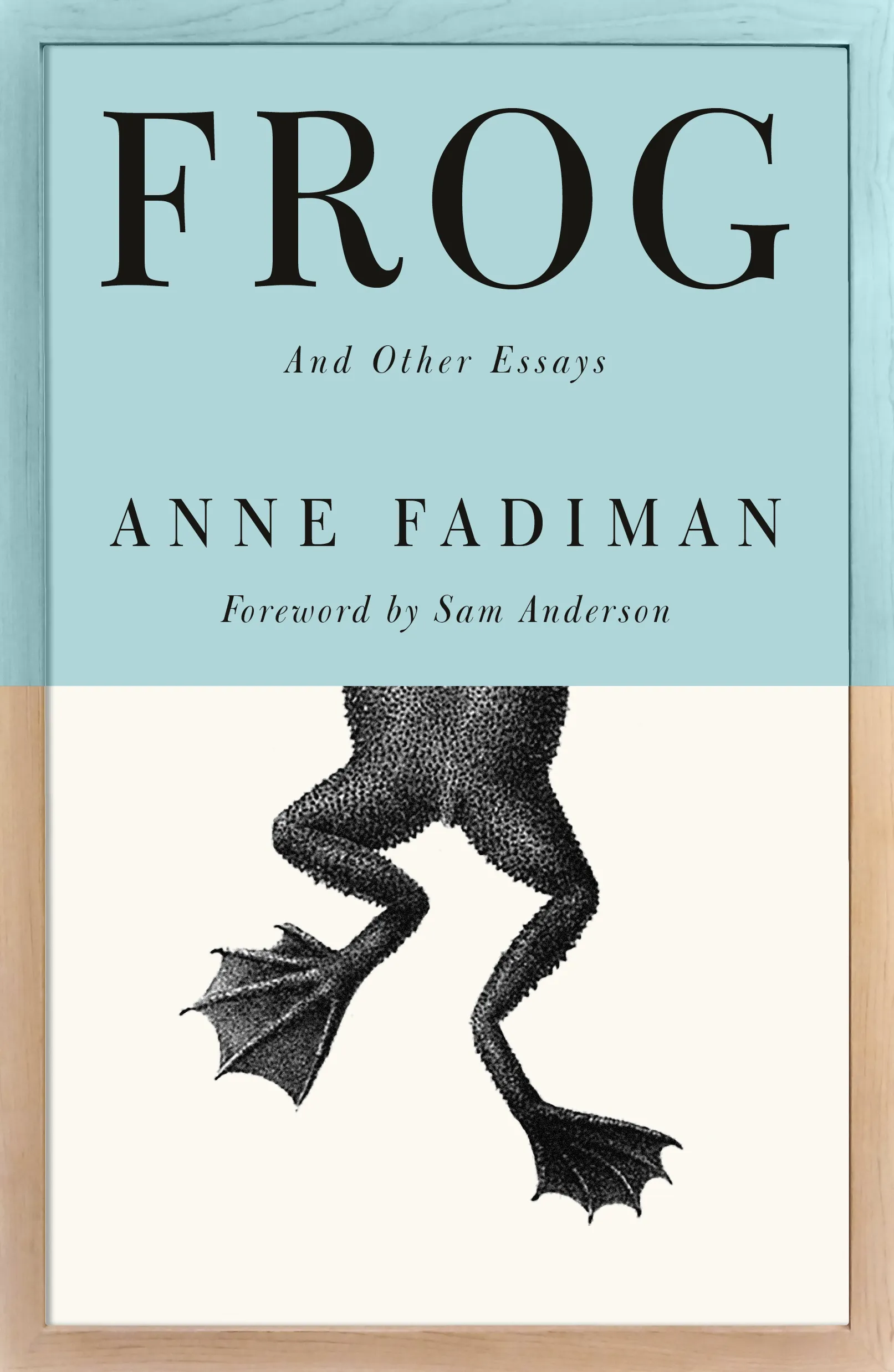 |
Late last year, in front of a live audience at Brigham Young University, in Provo, Utah, Anne Fadiman sat down with Fourth Genre editors Joey Franklin and Patrick Madden to discuss her long career as a writer and editor. Anne is the author of several books, including The Spirit Catches You and You Fall Down (1997), which won a National Book Critics Circle Award, The Wine Lover’s Daughter (2021), a memoir about her father’s love (for her and for wine), and three collections of essays: Ex Libris: Confessions of a Common Reader (1998), At Large and At Small (2007), and her latest book, Frog and Other Essays (2026).
Fadiman is among our finest living essayists, and we happily place her on our shelf among Montaigne, Lamb, Emerson, Woolf, Baldwin and other greats of the genre. Intimate, curious, and meandering, her prose reveals a hearty, erudite, clever mind at work. Whether she’s writing about ice cream, post 9/11 flag culture, her father’s wine collection, or the dead pet frog in her freezer, she not only entertains and informs, but as she burrows beneath the surface of things, she reveals subtle but essential truths about humanity. Her work is deep but teachable, rigorous but affable, probing but gentle.
What Emerson once said of Montaigne we might well say of Fadiman:
[“She] talks with shrewdness, knows the world, and books, and [her]self, and uses the positive degree; never shrieks, or protests, or prays; no weakness, no convulsion, no superlative; does not wish to jump out of her skin, or play any antics, or annihilate space or time; but is stout and solid; tastes every moment of the day; likes pain, because it makes [her] feel [her]self, and realize things as we pinch ourselves to know that we are awake. [She] keeps the plain; [she] rarely mounts or sinks; likes to feel solid ground, and the stones underneath.”
Note: This interview has been edited for grammar and clarity.
Pat Madden: Joey and I have been long-time admirers of your work, and we’re thrilled to speak with you. We discussed how best to lead off, and we thought we’d throw you a softball to start with:
Can essays save the world?
Anne Fadiman: I’m not sure that anything can save the world, but I do think that essays can move the world in the right direction. When I looked at your website, I was thrilled to see that you had written quite a bit about Montaigne. For those of you who, unlike Pat, are not authorities on the inventor of the essay, Montaigne was a 16th-century Frenchman who noodled around in a tower library at his chậteau in Bordeaux, writing about things like friendship and kidney stones and thumbs. He decided that he wanted to invent a new form that he called an essaie . Those of you who speak French know that comes from the verb essayer, which means “to try.” In other words, essays were attempts. They were not supposed to be perfected, polished things, and therefore they could be a lot more vulnerable, confessional, and generally weird than any previous genre.
It seems to me that if you apply it to other things, Montaigne’s spirit of experimentation and risk-taking is probably the only way to save the world. So, yes, metaphorically speaking, essays can save the world.
PM: I agree, absolutely. That was the exact right answer, the one I was hoping for.
AF: But we didn’t confer in advance. I want the audience to be assured of that.
PM: Of course not. I’m curious about your progress as a writer—your first book, The Spirit Catches and You Fall Down, is quite different from the ones that followed. You’ve since published three essay collections and a memoir. The later books are more personal, less reported, more miscellaneous. They chase down your interests and allow readers to hook into the interest themselves. How have you found the response to your later nonfictional works in comparison to the first book, and what do you think that might say about how the way the world is working, what it focuses on?
AF: I’m not sure it says anything about the world. It certainly says something about me. For my first fifteen years as a writer, I was purely a reporter. I became an essayist only because after I had two miscarriages, I was stuck in bed while I was pregnant with my second child. I couldn’t go out and report. I had a long talk with my husband. Well, gee, eight months horizontal; what can I write? It was either book reviews or essays. I’d already written a few reviews, and I didn’t want to spend eight months thinking only about other people’s writing. I’d never published an essay, and I thought, okay, I’ll give it a try! So I started writing essays, and then I just fell in love with the form, I guess, as Montaigne did in his tower.
More people have read my first book than all my essays put together, but that’s all right with me. For one thing, essays are a very good genre to write when you’re a parent. Reporting requires travel, and I didn’t want to be away from home for long periods. In fact, when my kids were little, the only times I was away from them for more than a couple days were the book tours for my essay collections. I didn’t have to go away for months, as I would have with reporting projects. So I ended up writing mostly within a genre that I knew wasn’t going to sell many copies, but that gave my family what it needed and gave me exactly the kind of intellectual and emotional sustenance I wanted. It was a great trade-off.
All my books, in whatever genre, have been fueled by curiosity. I would say that’s my most essential quality. I’m curious whether I’m reporting and interviewing other people about their lives, or I’m doing background research for the essay collections, or I’m learning new things about my father, the subject of the memoir, years after his death.
Joey Franklin: You’ve written literary journalism, essays collections, and a memoir, but I’m curious: as a writer, do you approach those genres differently, or is it all the same thing, just different tools? Talk to us a little bit about your genre approach as a writer.
AF: On the sentence level, the challenges are pretty much the same–I’m always trying to make shapely sentences. But their shapes are different. in my first book, The Spirit Catches You and You Fall Down, I was writing about a medical case that turned out tragically, so I didn’t feel it would be appropriate to put in a lot of stylistic curlicues and furbelows. The spotlight needed to stay on my main characters. I permit myself to play around a lot more in my essays.
But that doesn’t mean that there wasn’t humor in the first book. The family I was writing about is Hmong. The Hmong have dealt with tragedy throughout their long history by telling very funny folk tales. They taught me the lesson that it’s possible to be comic and tragic within the same work.
All my books, in whatever genre, have been fueled by curiosity. I would say that’s my most essential quality. I’m curious whether I’m reporting and interviewing other people about their lives, or I’m doing background research for the essay collections, or I’m learning new things about my father, the subject of the memoir, years after his death. So although each project is a river flowing in a different direction, they’re all coming from the same source.
JF: You brought up curiosity. Do you think curiosity can be taught? Or are we hopeless if we weren’t born in Fadiman University*–the kind of cultivated literary curiosity that seems to have shaped your childhood. Can you teach it to students? Can you cultivate it?
*In “The Joys of Sesquipedalians” (Ex Libris, 1998), Fadiman tells us that her erudite, eccentric family loved Sunday afternoon’s G. E. College Bowl on television so much that they dubbed themselves “Fadiman U.” and played along each week. “We viewed all forms of intellectual competition as a sacrament, a kind of holy water, as it were, to be slathered on at every opportunity with the largest possible aspergill,” she writes. And later: “It was an article of faith in our home that Fadiman U. could beat any other U, and indeed, in five or six years of competition, we lost only to Brandeis and Colorado College.”
AF: Literary curiosity is just one kind of curiosity. My first book didn’t really come from literary curiosity. It came from my curiosity about people and cultures. I learned about two cultures that I knew nothing about, the culture of the Hmong and the culture of medicine. I didn’t realize medicine was a culture until I’d spent some time in it, and thought, doctors have their own language, they have their own customs, they have their own prejudices, they even have their own costumes. They’re a culture too! That wasn’t literary curiosity.
Everyone is born with curiosity. In fact—I know that you two are both fathers—no one is more curious than a four-year-old child. I would say age four is the apex of curiosity. I’ve saved a list of the questions our son asked when he was four. For instance: “Sharks are fast. Do they have inboard or outboard motors?” Now, that is the kind of curious question that we stop asking because we start being embarrassed to admit our ignorance. Of course, sharks have outboard motors, everybody knows that.
I don’t think we teach curiosity. We just try to revive the curiosity that everybody already had as a child.
I remember when my daughter was two, another mom told me that you can’t be a type A walker when you have a two-year-old. They see a dog, or a flower, or a window, and they stop. We lose that exploratory spirit once we’re taught to be goal-oriented. Curiosity isn’t goal oriented. It’s just the opposite. I want to revive that inborn love of meandering in my students.
JF: And how do you do that?
AF: Give them stuff to read that surprises them and that lets them hear a lot of different voices. Give them writing assignments that make them uncomfortable and in which they’ll make some mistakes. They’ve all been so successful, I want them to fail.
There’s a quotation that I absolutely love by the journalist Daniel Levitt, or maybe he was quoting someone else: “I never fail. I either win or I learn.” I think about that every single day in my life, but also in my teaching. If you feel you always have to succeed, of course you don’t take any risks, because you need to keep on doing all the things that have won you “A’s” in the past. If you’re willing to get off that path, to meander a little, to be more like Montaigne, to make some experimental attempts, all of that revives curiosity. I also encourage my students to take my classes pass/fail. Almost all of them would get high grades, but usually at least half opt for pass/fail. Taking grades off the table helps good writers take more risks and get off that straight line.
I don’t think we teach curiosity. We just try to revive the curiosity that everybody already had as a child.
PM: I’m reminded of taking my son to the playground when he was probably about four, and he kept stopping to look at things. I was getting frustrated because I thought we needed to get to the playground, which was, you know, the goal of play. Then, luckily, I realized he was doing his playing already. He was playing by watching ants on the sidewalk. I felt chagrined at my own impatience, but also at least happy that I could recognize that this was a lesson from the universe.
AF: Yeah, the universe and all four-year-old kids already know that the journey, not the destination, is the destination. We unlearn that as we grow older, but sometimes we’re able to relearn it from our kids. That’s one of the great things about becoming parents.
PM: We were talking last night, and I think it might be useful and inspiring for people to hear about your Yellow Pages assignment for your students.
AF: I teach nonfiction writing classes at Yale. The one that I teach in the fall is a literary journalism class, essentially the genre of my first book. The final assignment is a long profile of someone in New Haven with an interesting occupation. I call it the Yellow Pages piece. Twenty years ago, the Greater New Haven Yellow Pages was about a thousand pages long. It was an actual book that contained listings for thousands of local businesses. Everybody used it to find their plumber or their dentist or whatever. Although it’s still printed, it’s very, very thin now. I give my students old copies as well as new copies and instruct them to find someone to profile. You might be asking, why can’t students just decide what occupation they’re interested in and Google it? Well, they are allowed to use Google eventually, but they have to page through the Yellow Pages first. Of course, my students, like your students, have never seen the Yellow Pages before. To them, it’s a bizarre American artifact.
As they page through, they see occupations they didn’t know existed. And they see occupations they’ve heard of but hadn’t thought of. Just recently, one of them said, “When I got to the E’s, I saw Electrician. It hadn’t occurred to me to Google ‘electrician.’ But I started thinking about how when I press a light switch, I have no idea what makes the light go on.” Well, now we’re talking about curiosity!
So I make them read the Yellow Pages, find some categories they’re interested in, and only then, if all the old listings are obsolete, are they allowed to use Google. And boy, are they having a great time this semester with their clock repairman, their equine therapist, their jukebox repairman, their gun instructor, and eight other occupations. Talk about curiosity!
PM: I imagine every time you assign that, you learn a lot yourself from what they write. It’s like you’re sending out your spies to report back on the cool things of the world. Do you ever encounter a subject that doesn’t interest you?
AF: No, because if my students are interested enough—and they always become extremely interested—they’re going to make me interested. I have to rely on that principle with my own essays as well. They’re often about things that I’m incredibly interested in, but my readers aren’t. Or, rather, they don’t yet know they’re interested.
I had a student once whose family owned a plumbing company. They said, “My family made its money by selling toilets, and I have no idea how they flush. So I’m going to write about a plumber.” Well, I’d never been that interested in plumbing, but, boy, in the hands of that student, I was.
JF: Maybe we could talk about one of the pieces that you’ve written in your new book, Frog, that did the same thing for me: “The Oakling and the Oak.” Hartley Coleridge was not on my mind as someone I might find immediately interesting, but you’ve written this incredibly delightful essay where you’ve done extensive research and put that curiosity to work. Could you talk to us about the process of researching and writing that essay?
AF: Sure. I’d long been interested in the early nineteenth-century poet Samuel Taylor Coleridge, one of the greatest members of the British Romantic movement. He wrote some of my favorite poems. I first read “Frost at Midnight” when I was in high school–so, a long time ago.
In my third book, I wrote an essay on Coleridge’s life and learned that he had a son named Hartley who was also a poet—a good one, and a good essayist too.
Hartley was brilliant but had a sad life, partly because he was always in the shadow of his famous father. He published one book of poems during his life. The reviewer said that his father’s genius had settled upon his shoulders, as if his only talent came from his father and he had none of his own. The reviewer also quoted the adage, “The oakling always withers beneath the shadow of the oak.” Hence the title.
I’m interested in oaklings because both my parents, now dead, were writers. Although it’s wonderful to grow up with writer parents, there’s also that oakling/oak downside. Are you always in their shadow?
I was very interested in thinking about why Hartley withered and I did not. What was I given by my parents that he wasn’t given by his? How have things changed since then? And so on.
I was asked to give a lecture on poets’ letters at the University of Sheffield in England, and I thought, aha! I bet Hartley and his father wrote a lot of letters. Maybe I can read them all, and all the letters that other Romantic poets wrote about Hartley, and make the letters the basis of this talk, which then evolved into the essay.
Most of the letters had been published, but for a few of them I had to write to the Harry Ransom Center at the University of Texas, which has a big Coleridge archive. They sent me scans. Both Coleridges had terrible handwriting. Deciphering it was like detective work. I was excited because zillions of people have written about the father, but virtually no one has written about the son. It was easy to become a comparative expert because there are only about ten people in the world who know anything about Hartley. And of course, since I’m an oakling and not an oak, my sympathies lie mostly with him.
JF: Is there something in that research that stands out to you as really essential to the project, the kind of thing that you didn’t know you needed until you found it, and then it opened doors?
AF: Yes. I’d read biographies, but there’s something about letters and diaries, in this case letters, that’s so personal. With a diary, you often feel that no one is going to read it but you, so it tends to be extremely honest. Letters are not always honest. Sometimes they’re what you think the other person might want to hear. But because you never imagine that anyone but that one person will ever read them and they tend to be dashed off in a single draft, they often feel straight from the heart.
I remember finding one quite shocking letter that Coleridge the father wrote to Coleridge the son when Hartley was ten. They were about to visit some relatives, and Samuel gave Hartley really harsh instructions about how to behave. I thought, oh my gosh, the father is criticizing the son for all of the father’s faults! The father was projecting them onto this innocent, malleable child. I thought, I’m never going to get that from a biography. I can get that only from this really personal communication.
So, for you students here today who are writing English papers: a lot of journals and diaries of people that you might be writing about are online, and I assure you, you’re going to find out personal, exciting, heartbreaking things about them that you’ll never, ever find any other way.
PM: I know you’ve written a prior essay about Samuel Taylor Coleridge, and this one’s about Hartley. So, I have a stupid question. Are you aware of and are you a fan of musical interpretations of “The Rime of the Ancient Mariner” by Iron Maiden and “Xanadu” by Rush?
AF: No. But the very fact that you’re asking this question suggests that you are. It means that your literary curiosity spans genres. I’m totally impressed.
PM: The connection I wanted to make is that there’s high art and low art, and you talked about your shapely sentences before. One of the things that impressed me most about your voice and your literary style is that it is both high and low. You include some doggerel poetry for your, uh, dog, I guess. It also involves the frog. But you also, within the same pages, use words that I have to look up, and then slang words. Sometimes we think of shapely sentences as the high art of sentence writing, but you’re also quite comfortable with the low art of colloquial speech. Do you feel like that’s a conscious decision, or do you just let the words flow?
AF: Well, I believe in bringing my whole self to my writing. That is especially easy if I’m writing a personal essay, because putting myself on the page is the whole point. I’m gambling–hoping the odds are high that the reader actually wants to listen to me. If they don’t, they aren’t going to get beyond the first page anyway. But if they keep reading, I’d be shortchanging them if I used only parts of my voice. I do not consciously think, oh, time for slang, oh, time for a long word. But neither do I just let it all flow, because I’m a really slow writer, and I revise a lot.
I believe in bringing my whole self to my writing. That is especially easy if I’m writing a personal essay, because putting myself on the page is the whole point.
JF: I’m going to change the subject a little. The first essay in your new book, “Frog,” is about Bunky, the dead pet frog you kept in your freezer. It got me thinking about Georg Lukács’ famous quote that every essay begins with the unspoken phrase, “thoughts occasioned by . . .” I imagine that essay was “thoughts occasioned by the frozen dead frog in your freezer.”
AF: [Laughs] Now you don’t even need to read it.
JF: You had the frog for sixteen or seventeen years, then it sat in your freezer for . . .six? At any point in that long tenure of the frog in your care, or storage, did you think, this is something I’m going to write about?
AF: Yeah, sure.
JF: And the follow-up to it—did you keep it in the freezer longer, knowing you were going to write about it?
AF: No. No. The idea of every essay, as Georg Lukács said, is “on the occasion of,” of course. So many of the essays in one of the periods that you and I love—the essays of Lamb and Hazlitt—begin that way. “On friendship,” “On going to the theater,” “On difficult relatives,” or whatever the subject may be. So, yes, I do think that’s true with essays. And if it’s an essay about eleven different things, it’s a bad essay.
I did think I might want to write about our frog, Bunky, because I was interested in the kind of relationship that families have with unpettable pets—the sort of pets that arrive by accident, that they have to keep but don’t really love—unlike the ones that they choose, like our dog Typo, for whom I wrote that little song you mentioned, which I never sang when anyone else was around. It had a tune and everything. The tune was just as bad as the lyrics. But Bunky never got a song.
I also thought I should write about Bunky because I had not been a good pet owner. I always tell my students to avoid clichés, and to avoid the generic, and to avoid sentimentality. And I always tell them that two emotions that cut through all of those things are shame and guilt. I felt guilty and ashamed that I’d given Bunky such a bad life, so I thought I’d better follow my own advice and write about him.
I didn’t keep Bunky in the freezer longer so I could put that in the essay—quite the opposite. After he died, my husband and I wanted our children to be there when he was buried, because we’d buried all of our other pets, or had them cremated and kept the ashes. Typo’s ashes are in a sort of sacred wooden box. But our children, who are now adults, were never home at the same time, except in the winter, when the ground was too frozen to dig. So years passed, and in fact, I thought, gosh, I can never write about Bunky because it’s just too weird to say that we had a frog in our freezer for six years.
I always tell my students, is there something that you think is too embarrassing to say? That’s the first thing you should say. So I began the essay with Bunky in the freezer. I try to practice what I preach.
PM: I want to shift gears. You’ve done important work as an editor too, and I am curious—what is the role of an editor in shaping public discourse? You were editor of The American Scholar on 9/11, and you commissioned pieces from writers in response to the terrorist attacks, including from one of our mutual friends and examplars, Brian Doyle. So, what is the editor’s role, and what can an editor do?
AF: Well, I think an editor is a lot like a teacher. I can’t say that I was thinking, oh, I’ve now become an editor. Now I’m a manager of public discourse. With each issue, I was simply interested in creating exactly the 100-plus pages that I most wanted to read. Who were my favorite writers? Oh my gosh! I’m going to send this person an email! “Would you write for The American Scholar?”
It was sort of like being the host of a party to which you get to invite not only your most interesting friends, but everybody in the world that you want to meet. I was never thinking about how the magazine might change the world beyond a basic faith that good writing does change the world. People might model their own writing and speaking after it, and it might make them think.
JF: Given that, and how we began—with the question of whether essays can save the world—how do you give yourself permission to write on miscellaneous personal and small subjects, when there’s so much pain and suffering and often a sense of urgency in the world?
AF: I don’t think all small subjects are only small. There were a lot of profound emotions in that frog piece. It was about loss, it was about family, it was about love and the limits of love. It was also about guilt and shame and the smugness of parents who think they’re good parents, but maybe, in fact, aren’t as perfect as they thought.
My third book was called At Large and At Small, because, yes, I am interested in small things, but I’m also at large in the world, and I like using a small thing to think about a large thing.
Anne Fadiman’s latest book, Frog and Other Essays, is out now from FSG. Buy it here.