
What We Mean When We Talk About Squirrels
A Few Contemplations on Points of Tangency
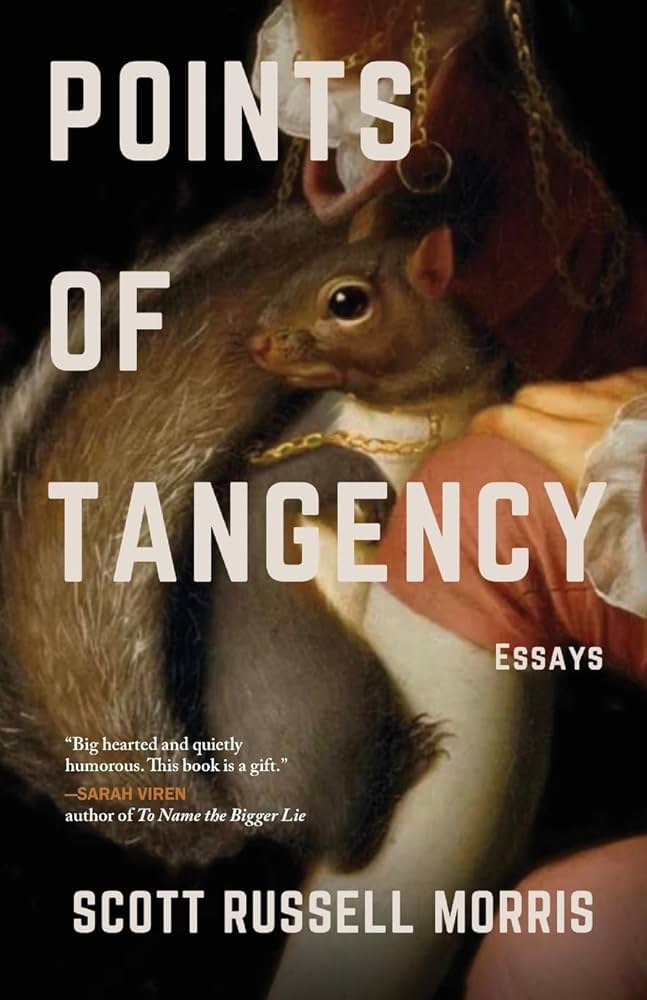 |
Points of Tangency By Scott Russell Morris 226 pp. Cornerstone Press, $24.95 Released September 2024 |
Squirrels are infrequent visitors to my yard in my little spot in the mountains of Utah. The local variety, the American red squirrel, is small and seems more like a chipmunk to me than the picture I carry of what a squirrel should be—large and furry and bushy of tail. In fact, it hardly seems to have any tail at all. Those other, more traditional squirrels are not native to the climate and only recently, as of 2011, have I begun to see a species known as the fox squirrel on my wilderness forays up canyons and mountain trails, a large variety with bright red and orange tails, as they slowly begin to populate the wilder areas along streams and riverbeds, up the canyons and in the forest areas.
I have been thinking about squirrels lately. Mostly in connection with how very blind I have seemed to be to their existence before dipping my toes into the essays by Scott Russell Morris, whose fascination with the small woodland creature threads its way elegantly through the collection in small glimpses and bright flashes, and occasionally a full examination—the squirrel serving as an unlikely connection that ties together essays on hiking, traveling abroad, relationships, restoration, pies, gardening, religion, trains, and even a particularly enjoyable essay on nothing at all, a true wandering that encapsulates Morris’s status as an essayist—not a master of one thing, but a student of all things who takes great joy in finding the beauty and meaning in even the most mundane events of life.
I like to think I would have noticed them if I lived back East. The squirrels, not the essays. On the East Coast, a squirrel looks like what you think a squirrel should look like—all gray fur and black eyes and a voluminous tail curling elegantly behind them like some gentleman dressed to the nines. Our squirrels here in the West are more ordinary, less flashy, more likely to be disguised as an odd kind of chipmunk or gopher or wood rat. Points of Tangency, much like these Utah squirrels, takes something we think we understand—namely the shape and form of an essay—and makes of it something that feels a bit like a quiet revelation. Each thought leads not to a preconceived destination, not to where I thought it would when I first opened the book, but to something that looks a little bit different, a little bit unexpected, a little bit less flashy, but far more satisfying by the end.
As the title implies, Morris looks at the world around him and makes unexpected connections about the domestic details of his life (By using the word “domestic” here, I think it is worth clarifying, I do not mean domestic in the sense of chores, or the sense of family work or labor. No, domestic in this instance, I think, encompasses all the small details that speak of home, that recall the ordinary, that bring to mind the commonplace, which in reflection is not very common at all, and is very much worth the time to contemplate.). By shining a light on experiences that could very well be forgotten—by languaging them, and sometimes even laughing at them—we see that things we may have dismissed as insignificant at first glance become truly important by the end. They are the threads that bind us together as we share experiences, feelings, and even, in some cases, physical items. Morris is, in effect, using language and meaning to create of us a community mesmerized by the movement of squirrels on the page, eager to observe and reflect and remember.
In Morris’ sometimes frequent asides about squirrels we find a sense of whimsy and wonder, not only for his own passions and interests, but for enthusiasm itself, an enthusiasm which he delves into more deeply in the essay The Common Area, an in-the-moment, present tense contemplation of his time on study abroad that manages to acknowledge the tropes and clichés of what he calls the Eager Young American, without falling into those same traps, mining memories of unexpected conversations, connections, and contradictions that leave the reader with an uncomfortable feeling of walking a new landscape, unsure of our welcome or even, really, of being understood.
Morris does not reserve his attention to detail for squirrels alone. The essays themselves range from wandering prose to highly formal poetic structure that lends meaning in surprising ways, such as in the essay Triptych: A Study in Comfort, which offers a brief glimpse at becoming comfortable with the revelations of discomfort, all wrapped in a poetic form that moves from past to present to future and reveals, through juxtaposition, the awkwardness of new growth and the peace of old intimacies. In Pie Month, the concreteness of the effort—Morris’s admirable and enthusiastic goal of making pie every day of the month of March 2014—grounds the reflection and meditation of the essay in layers of playfulness, quiet difficulties, and the occasional desire for a recipe to be handed down on a scrap of paper torn from the page (I am personally intrigued by Cauliflower Pie with Potato Crust).
I have never before written about squirrels, but I do write quite frequently about frogs. I find myself wondering if my frogs are the equivalent of Scott’s squirrels—a device of wonder and enthusiasm that allows more challenging thoughts the freedom to appear on the page. At the heart of it, we must end where Morris begins in his essay Nothing In Particular—with the realization that we have nothing to talk about and that our thoughts are squirrels darting from tree to tree in search of a branch from which to view the world. But the nothing is not a desolate wasteland in search of some spark of life, but a blank page in search of inspiration—and the essays in Points of Tangency offer both inspiration and a model. Morris’s very awareness of the squirrels that plague us all becomes a guide to the various places where they can, unexpectedly, pop up.
We are all, each of us, a collection of small moments. We are all observers of coincidence. And we are all the squirrels racing through the branches overhead.

Shelli Spotts
ShelliRae Spotts is an essayist, advocacy writer, screenwriter, and sometime poet who teaches creative writing and composition at Brigham Young University. She is passionate about exploring the ways we use stories to build bridges within our communities and her essays delve into the connections we discover through languaging our lived experiences. Her creative work has been published in Inscape: A Journal of Literature and Art, Locutorium, Poets.org, and elsewhere. Shelli is the author of a forthcoming essay collection, “Radical Domesticity: On a New Economy of Care.” When she is not teaching, writing, or reading, Shelli loves to spend time with her husband and four ‘almost adult’ children watching Marvel movies, attending the theatre, or dragging everyone outside to “look at the sky.”