
Stories of the Street
Reimagining Found Texts
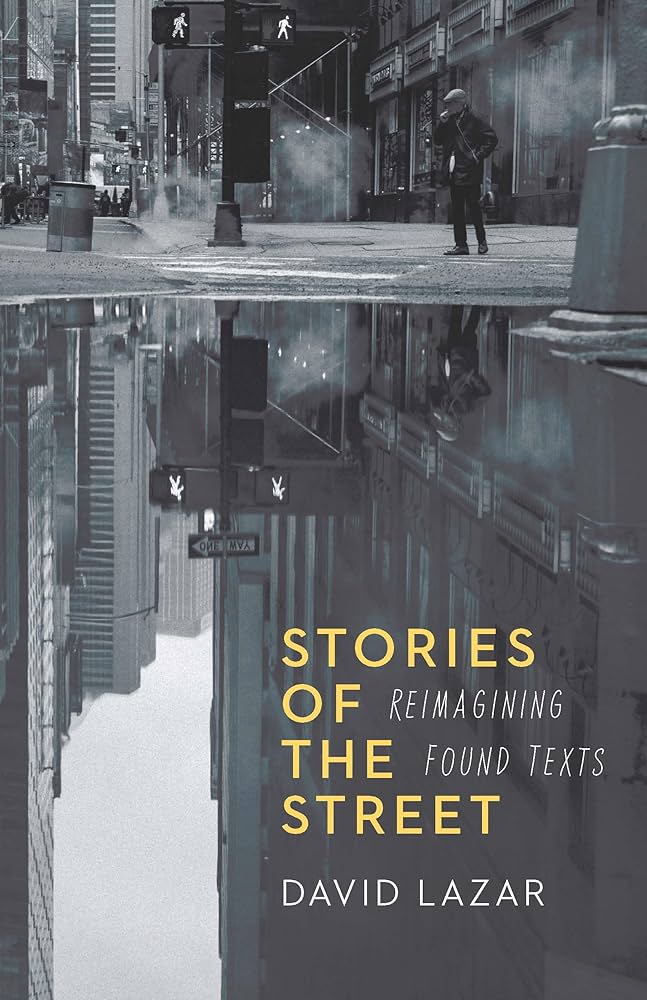 |
Stories of the Street By David Lazar 136 pp. Nebraska Press, $24.95 Released November 2024 |
Recently, I taught a workshop in hybrid forms, focusing on the ways that prose and poetry must sometimes collide if we wish to represent the slippery, liminal parts of our lives. Our reading list included Edward Hirsch’s Gabriel, a book-length elegy about the sudden death of his son, which is comprised entirely of discursive, unpunctuated tercets. We read Anne Carson’s Autobiography of Red, a novel in verse that reinvents Greek mythology to explore queerness, monstrosity, and an artist’s coming-of-age. And we read Charles Baudelaire’s Le spleen de Paris, the groundbreaking collection of prose poems and vignettes from 1869 that introduced readers to the figure of the flâneur, an impassive, urbane, wandering man of the city. Certainly, David Lazar’s latest project, Stories of Street: Reimagining Found Texts, would have been well-suited to the concerns of my syllabus. It’s a book that not only works in the tradition of Baudelaire but that is also engaged with Walter Benjamin’s scholarly interest in the flâneur, a character Benjamin describes as “happy to trade all his knowledge of artists’ quarters, birthplaces and princely palaces for the scent of a single weathered threshold or the touch of a single tile—that which any old dog carries away.”
Stories of the Street opens with an address “To the Reader” (a likely nod to Baudelaire), in which Lazar argues that “the ground is full of messages.” Over the last decade, the author explains, he took to noticing, recording, and writing about found texts he encountered in major cities like Chicago, New York, and London. Through this process, he realized that such scraps of language discovered on walls, streets, and sidewalks “might be revelatory if given time.” Torn pieces of newspaper articles, a plastic knife, an unsigned petition—each item is photographed and then becomes an opportunity for ekphrasis, description of the image inevitably leading to self-reflection. “The world is a bottle with no message inside,” Lazar observes. And by positioning himself as a modern-day flâneur, the writer maintains a detached perspective from which he can construct an unexpected narrative, can find meaning in the debris.
Stories of the Street has a loose, associative structure. We shift back and forth between photograph and the language of flash. Exposition is usually eschewed, so that the reader must confront the found objects in a way that feels almost unmediated. The effect is that we too are transformed into flâneurs and now wander the city alongside Lazar. A photograph of a mysterious list, for example, is paired with a vignette whose contents are inspired by the cryptic words contained on that list:
Some of Lazar’s ekphrastic responses function as close readings of the found text. Some are acts of imagination. Some are digressions. Others are recollections, opportunities to turn inward toward an earlier iteration of the self. And because it’s difficult to predict which approach Lazar will choose, the book reads quickly, as if we are being told to hurry from one city block to the next, rushing to a destination we don’t yet know.
My favorite moment in Stories of the Street occurs when Lazar uses a found object to address history. A vignette titled “Jewish Museum” is paired with a photograph of what resembles a luggage tag, and through this juxtaposition Lazar reflects on the Shoah. He conveys how present-day Jewish life is haunted by ghettoes, mobile killing squads, and death camps, by those mountains of shoes and suitcases now displayed behind glass at the Auschwitz-Birkenau State Museum. Lazar projects a narrative of deportation and extermination onto the paper tag. “Where’s your case, darling?” asks a mother anxiously. “It should have been tagged. Things around here are supposed to arrive on time?” In fact, I was not surprised that Lazar placed “Jewish Museum” shortly after a large grouping of photographs of lost shoes. These misplaced sneakers, slippers, and Mary Janes evoke the work of sociologist Lea David who discusses in A Victim’s Shoe, a Broken Watch, and Marbles: Desire Objects and Human Rights the power of artifacts dropped—or cast away—at sites of genocide and atrocity. David asserts that the most resonant of what she calls “desire objects” are shoes, paired or uncoupled, because they “represent the absence of the humans who once wore them, their materiality a metonym for corporality obliterated.”
Indeed, Stories of the Street is preoccupied with the presence of absence. Who once possessed these lost things? Where have the owners gone? Do they miss what they left behind? Near the end of the book, Lazar’s photographs render the found objects nearly illegible; as a result, we are forced to trust the writer’s interpretations of these inscrutable messages. In the final pairing of photograph and word, “Telling a Story,” Lazar poses a numbered sequence of “reading comprehension questions” about a piece of paper whose words we cannot read, including “How significant is the absence of the story?” and “Does this seem to be connected to the role of Z?” Unable to parse the original source material, the reader cannot expect to pass this pop quiz. Stories of the Street leaves us, instead, with interpretation and uncertainty, a realization that the world resists our comprehension. If we try to offer an explication de texte, we must accept that there will always be unfillable, exquisite, tantalizing gaps between the lost object and its owner, between photograph and vignette, between prose and poetry.

Jehanne Dubrow
Jehanne Dubrow is the author of three books of nonfiction, ten poetry collections, and a
craft book. Her book-length essay, Frivolity: A Defense, is forthcoming from Columbia
University Press in 2026. Her writing has appeared in numerous literary journals,
including New England Review, Southern Review, and Ploughshares.