What It Means to Be Seen by a Bear
and Other Thoughts from The Season of Birds and Stones
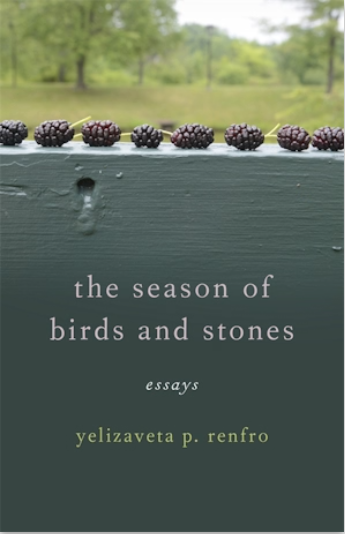 |
The Season of Birds and Stones: Essays by Yelizaveta P. Renfro 200 pp. University of Georgia Press, $24.95 Released March 2026 |
“Perhaps the first rule of everything we endeavor to do is to pay attention. Perhaps the second is to be patient. And perhaps a third is to be attentive to what the body knows.”
― Barry Lopez¹
I read The Season of Birds and Stones from a hospital bed while recovering from scarlet fever, an illness a young doctor had waved away only days earlier, assuring me I was “fine to go to work.” I remember the crackle of the exam-table paper beneath me, the room swimming in and out of focus, my head drooping with exhaustion while he calmly insisted nothing serious was wrong.
But my body already knew otherwise.
While recovering, I opened Renfro’s essays and found myself met by a kind of quiet, bodily wisdom. Her attention to the natural world—its tremors and consolations—aligned with my own vulnerability, as if her prose recognized the clarity that accompanies illness, when the senses think first and language follows after.
In the title essay, “The Season of Birds and Stones,” Renfro writes, “I would always choose words, as imprecise and inadequate as they are,” acknowledging she repeatedly encounters “the limits of language.” Yet she also admits that “in noticing and speaking what was around me, I anchored myself to the physical world, the tenuous, abstract tethers of language securing me to the corporeal.” Naming becomes a form of devotion, even when it fails—especially when it fails.
Motherhood, too, resists easy language. Renfro calls herself “an ambivalent mother”: not ambivalent about loving her children but about how to be a thinking, perceiving woman inside the daily labor of caregiving. The essays hold this tension with tenderness, revealing motherhood not as a fixed role but as an evolving field of perception.
“The Birds I’ve Known,” my favorite of the short interlude essays, carries the potency of a lyric fragment. Renfro offers a catalog not of species but of fleeting encounters with the birds that have marked her life—moments of recognition, startle, or shared attention. “Every bird is a story,” she writes, “and I have known only the briefest beginnings of most.” The form mirrors this claim—each encounter offering a brief glimpse into the soft inner spaces that resist naming.
Her craft mirrors her inner complexity. Many pieces are segmented or braided, composed of short passages separated by white space. The form feels conversational with thought, with how the mind returns, leaves, circles back. The gaps invite the reader into the process, allowing meaning to form through echo rather than explanation. Fragmentation becomes a way of holding experience, not breaking it.
This movement is especially powerful in “The Twentieth Bear.” Renfro’s encounter in Denali is one of the book’s most striking moments—not only for its drama, but for how she renders being truly seen by a wild animal. She writes:
From there she moves into a deeper understanding:
And then the integrity of her quiet admission: “It will not be the bear’s story—it can never be the bear’s story—but remains ever only my own.”
Renfro’s descriptions carry this same integrity. Loons on Isle Royale, ground squirrels in Alaska, the ancient bristlecone pines of Great Basin—each appears not as backdrop but as a character with agency. Renfro is both a nature writer and a writer of place, attuned to how the ground beneath one’s feet can alter a life. She writes place the way one writes a beloved: with attentiveness, curiosity, and a willingness to be changed.
As someone who grew up visiting Great Basin National Park, near where my Grandma Hope lived in Ely, Nevada, I felt a tenderness toward “Panorama of a Life.” My grandmother, who lived to ninety-eight, felt bristlecone-like to me in her endurance, her seasons, her weathering. When Renfro stands before those ancient trees, I hear echoes of both lineage and landscape—women and roots, aging and time’s slow turning.
Reading Renfro while feverish slowed me down. Her segmented structures encouraged me to linger, to sit inside her white space, to let the questions settle. What does it mean to truly see the world? How do we mother our children, ourselves, our memories inside landscapes that shift beneath us? What can we learn from creatures who do not speak our language but understand survival with an authority we lack?
Renfro never resolves these inquiries; she carries them. Her essays move by layering, by listening, by pausing long enough for connection to emerge. She is a scientist and poet, mother and wanderer; her prose moves with a quiet, exploratory steadiness that is curious, receptive, unafraid of uncertainty.
By the time I recovered, the world outside felt newly restored, sharper, more intricately webbed. Renfro had tuned me to a subtler frequency: the tremble between living things, the thin membrane between danger and wonder, the small moments that shape a life.
A book that returns you to the world with clearer senses and a softened heart is rare.
The Season of Birds and Stones is such a book—an invitation to look again, and more deeply.
Footnotes

Michele Broadbent Walker is an essayist whose work explores place, memory, family, faith, and the ethics of attention. She earned her MFA in creative nonfiction from Brigham Young University. Her writing frequently returns to the landscapes of the Mojave Desert and the American Southwest. She lives in Utah with her family.