
Our Bodies are Mostly Water
Reviewed
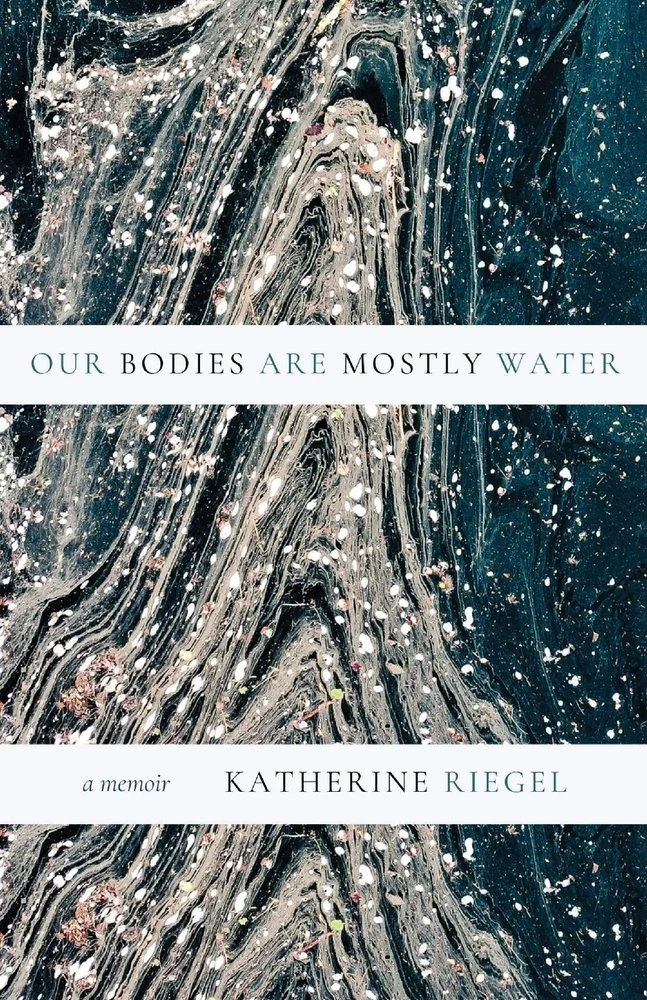 |
Our Bodies are Mostly Water By Katherine Riegel 150 pp. Cornerstone Press, $21.79 Released May 2025 |
Our Bodies Are Mostly Water, Katherine Reigel’s memoir in lyric prose, contains 88 pieces separated into 5 sections, that unearth and echo the particulars of grieving her sister’s death. Reigel begins her collection with a quote from Didion’s The Year of Magical Thinking, boldly placing her work in relation to one of the greatest writings on grief, and showing us that the work of writing death is never done. Just like Didion, Riegel finds her place in this impossible conversation, tackling something that can’t be pinned down yet aches to be grounded, named, defined, in order to give us a nuanced picture of the pain in loss: “I want, and I wish, and I miss her, and her absence is a dark howling emptiness.”
Loss is a great unifier; none of us can escape its pull. And though Riegel’s is a story of the specific loss of her sister, she renders it so clearly that it captures loss in its unending forms: “Loss isn’t a game, ever. Ask the bluebird whose egg never hatches. Ask the Hacked milkweed. Skin wants to be whole. Blood loves everything it touches.” Her descriptions ask me to name what my grief feels like (“When I’m confronted by suffering I feel jagged and spiky, self-conscious and useless”) pointing out that as universal as suffering is, it is also wholly unique–and a difficult topic to write about.
Death, loss, and grief are topics that can easily turn saccharine, heavy-handed, or purply. But Riegel balances the heaviness of her subject matter with a light hand, picking her moments where she turns up the poetry and others where she keeps plain speech to lay the grief bare. Numerous times, in different ways, she repeats the plain fact that her sister is gone: “My sister is dead,” “my sister is dying,” “she was dying,” “Dear now dead sister,” “She has died and the world is ending.” Her unapologetic way of claiming this unadorned truth of her grief is powerful, and echoes the way the truth is unrelenting in its repetitious reminder that the ones we love are gone.
I have loved ones who have been dead for years now–like many of us do. And I crave the simple truth that my parents are dead to come easily out of my mouth anytime anyone asks about my family, my story, who I am. Because I am nothing if not formed by the grief I carry. At one point, after simply stating that her sister is dead, Riegel writes, “This is a fact that I want everyone to know.” Another truth that applies to my own grief. I want to mourn in all black attire, write this review on stationary with thick black inked edges. I want everyone to know of the death that I carry like Riegel does, and when I read that line, as when I read many other of her lines, the work she is doing becomes clear: speaking her unique grief while connecting with each of us who grieve uniquely, silently, solely on our own but who simultaneously want to be un-alone. We keep writing about grief, because it keeps churning us—all of us.
When Riegel finds the emotional space to open up, inviting her to leave simple language and move into poetry. Metaphors abound, aiding her in grasping shapeshifting loss and the life it steals in all of its forms. Describing her sister’s brain injury, Riegel writes, “she grew up wearing the symptoms of this injury like the clanking tin cans tied to the back of a newlywed couple’s car, with everyone around her assuming she could just cut the strings and free herself.” Trying to describe her sister’s power, Riegel writes: “The inside of her lit up–like when you put a flashlight inside a balloon.” I have never done this–stuffed a flashlight inside a balloon–but I find myself wanting to know how the color would glow and also completely understanding what this would look like without personally experimenting. I can imagine how it could mirror the way an individual lights up as they exude energy while explaining the things they love, the passions they carry and share in the world. Of course they would become literally brighter in all their solidness, light trying to make its way out. And one of my favorites, when describing the pain of losing her sister: “I feel you like a lost leg.” Of course someone running alongside you in life for forty years would feel like an extra limb, and losing them would feel like a throbbing nerve screaming for its amputation. But the most painful metaphor Riegel shares is that of the beat of her heart: “It’s just that big bass drum doing nothing but shouting its existence while someone I love suffers while suffering wheezes words no one wants to hear and the rest of us make the choice we must make every day: despair or life.”
Just as the prose varies in its approach to poignancy, the length of these pieces also saves us from drowning beneath the weight of this pain. While this is a collection of mostly brief renderings—with some pieces using only a few sentences—there are several moments when Riegel opens up a piece to sprawl onto the next page, providing a relief of release in letting her thoughts and writing take up more space and time, trying to make sense of the senseless. In these moments, she takes time and love to reveal her sister’s truth, minutely and carefully with curiosity, but also with a confidence that surprised me. We are often told as essayists to not assume the internal thoughts or realities of those we write about and to have caution when telling other’s stories.
In Phillip Lopate’s essay, “The ethics of writing about other people,” he brings up the very questions that are at the center of Riegel and her collection. Lopate writes that he is often asked, “How should one deal with writing about one’s family members or intimates? How does one balance the need to tell one’s story with the pain others might feel in being exposed this way?” Throughout his essay, Lopate offers various answers to these questions, but none as in-line with what Riegel does in her collection as when he argues that writing about others, “can also be a way of communicating something to loved ones you never could before—a ‘gift’ of the truth of your feelings.”
Riegel does take caution, admitting her limits in telling her sister’s story: “I carry her voice in my throat but I cannot speak all her truths, or all her lies.” But her caution and limits don’t keep her from artistry and from telling the truth as she sees it–this she does unabashedly.
Riegel’s sister is so alive on the page, I found myself having to be reminded that her sister is now dead. Riegel is walking through life without her, and she carries a terrible pain that I begin grieving as well. And yet, I’m grateful for this pain, for these words of knowing, for essays and memoir that show such life even when it is painful for both the writer to write and for us to read. This book is a gift.

Courtney Ruttenbur Bulsiewicz is an essayist whose writing has been published in Short Reads, Sweet, Cutbank, and others; you can read some of her work at courtneybulsiewicz.com. She is living and teaching writing in the Mountain West with her husband and two sons.