
A Little Blue Cabin on the Iowa River
Finding a Home ‘that Carries You Forward’
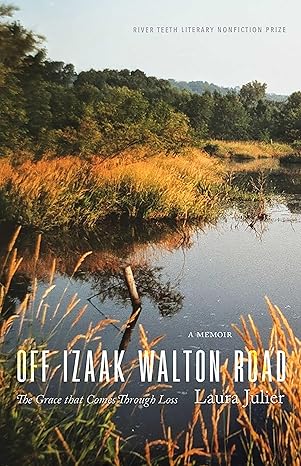 |
Off Izaak Walton Road By Laura Julier 272 pp. University of New Mexico Press, $19.95 Released March 2025 |
Laura Julier’s Off Izaak Walton Road is an extraordinary memoir in which the inner landscapes of self and personal trauma are mapped to, and transformed by, an indelible place. It is the story of a little blue Iowa cabin over seasons and years—the cabin, the marsh near the road, a particular expanse of the Iowa River and the snag in the middle, sometimes exposed and sometimes submerged. It is the tale of the maple and oak and marsh grass, bald eagles and barred owls and egrets, mice and cats and turtles and beavers, an entire ecosystem explored and catalogued. And it is finally, through sheer lyric force and intensity of focus, an interrogation of loss and what it means to hold onto sorrow a little less hard, to move through it until one understands the inevitability of change—that this too will pass.
Julier’s story centers on that little blue cabin and its environs on the Iowa River just outside Iowa City where she spent the better part of two decades living and, later, returning to visit. As she describes her emerging relationship with the cabin and the land and river, she investigates her personal experiences of home and safety—her East Coast urban origins, her first house in Iowa City and all she left behind when she moved to Lansing, Michigan, to teach at Michigan State; her struggles to find a place there where she belonged. She details her growing attachment—bordering on obsession—with the rustic blue cabin where she house-sat, a place barely insulated and heated by woodstove, set back in the trees but not, as she discovers one unsettling night, beyond crawling distance from the nearest neighbor. She asks what it means to really inhabit a place—to know it so deeply that one might claim a sense of real belonging. And she admits, finally, to engaging in a sort of magical thinking: imagining that such an intense dedication to knowing one’s local environment, in all its history and flora and fauna, might cast a spell of healing and protection over the human who resides there.
Any of us who have ever loved a place, ever settled into the rhythms and nuances of a house and garden and forest can relate to the attempt—and to the revelation that place cannot be saved from fire or flood, let alone our own histories of harm.
If there is a narrative tradition to invoke, it is probably Thoreau—people enter and leave this book, including Julier’s parents and friends, as well as R, the owner of the cabin, and her immediate neighbors. But this is a book about solitude and the natural world, about realizing and reifying the self through discursive observation—naming the birds whose wings flash in the distance, understanding the method of the beaver in constructing its dam branch by branch, counting each creature and discovering their habits. Perhaps Annie Dillard’s Pilgrim at Tinker Creek is a closer analogue to Off Izaak Walton Road; certainly both books share rich, precise, graceful prose from female narrators concerned with the self in nature.
Yet Julier’s landscape is not some unsullied Eden, or even a place of great remoteness. The cabin’s neighbors cut firewood and backfill the marsh, and the book is less concerned with the glory of charismatic megafauna than it is with the grittiest and most mundane details: saving the mice from the housecat, sussing out the daily toll of the busy road’s heavy-tired vehicles on turtles and frogs, cataloging and sourcing the stream of litter tossed in the ditch and what it means. The book is not about purity—spiritual or psychic or natural—and for all its digressive seeking, it offers few answers, because the size and scope of the question is existential: How should, and can, we live with ourselves as a part of the world?
Late in the book Julier scours county records, researches the geologic forces that created the landscape, and even tries out fishing as a means of knowing, despite her reluctance to pierce worm with hook. She is searching for something ineffable, that she accepts is in fact, finally, impossible. It takes a flood and the clarifying wisdom of years, but what Julier finally finds is not a home in a cabin on a river, but a sort of hardscrabble grace that she can carry with her, in the face of inevitable loss and sorrow.

Michael Copperman
Michael Copperman is an assistant professor in the Department of Writing, Rhetoric and American Cultures at Michigan State University. His work has appeared in The Oxford-American, Guernica, The Sun, Creative Nonfiction, Boston Review, Salon, Gulf Coast, Triquarterly, Kenyon Review and Copper Nickel, among others, and has won awards and garnered fellowships from the Munster Literature Center, Breadloaf Writers Conference, Oregon Literary Arts, and the Oregon Arts Commission. His memoir Teacher: Two Years in the Mississippi Delta (University Press of Mississippi 2017), about the rural black public schools of the Mississippi Delta, was a finalist for the 2018 Oregon Book Award in CNF.
Copperman was once one of the best wrestlers in the Western United States, and attended Stanford on wrestling scholarship. His next book, Seeking Eden, about the extremes of the American subculture of wrestling as seen through the story of five-time national champion Kenny Cox’s pilgrimage deep into the wilderness of Kauai’s Na Pali Coast, is forthcoming June 2026 from University of Iowa Press.