Dispersals
On Plants, Borders and Belonging
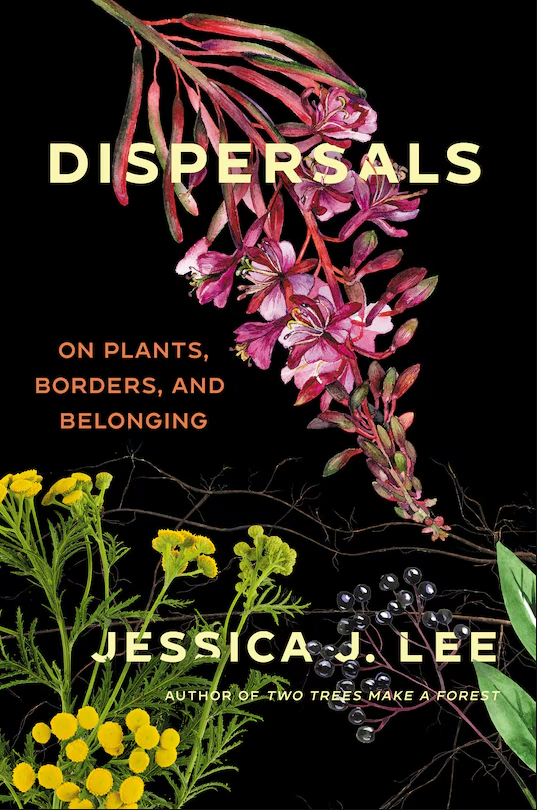 |
Dispersals: On Plants, Borders and Belonging By Jessica J. Lee 288 pp. Catapult, $26.95 Released March 2024 |
In Dispersals: On Plants, Borders and Belonging, Jessica J. Lee meditates on the various processes and experiences that take place when plants (and people) change locations. The book consists of fourteen essays that examine the parallels between plant migrations and human migrations, and each one beautifully combines research with personal anecdotes. In the essays, Lee writes about a wide range of plant species, including seaweed, heather, soybeans, and pine trees, among others.
Lee’s prose is melodic and colorful—in the sense that she vividly describes plants with the devotion of a painter—and reading her work is like being allowed into her thoughts and sometimes even her home. Early on in the book, she talks about the pond that her mother created in their yard. Later, in the chapter about soy, she describes the process of making homemade soy sauce. The care with which Lee prepares the beans for fermentation is apparent in her writing, as is the deeply meaningful nature of the work: “As much as I have wanted a child or a family,” she writes, “I’ve wanted to learn to make soy sauce.” Through the experiences that Lee relates, readers are able to understand her moments of worry and confusion, as well as her dreams and hopes.
Dispersals is not driven by a narrative arc that cleanly resolves at the end, but the way in which Lee weaves together the past and the present keeps the reader fully engaged. Much of the book is driven by her desire to find beauty, and as such, she spends a significant amount of time describing landscapes and plant species. In vivid language, she recreates for the reader things that she finds beautiful: “Some way into the middle of the purple field, the ground compacts and I find a path a little firmer underfoot. Dry summer has left the heather parched and spindly, and though it flames orange and red under the sunlight, everything is clouded by a fine film of sand.” Each essay is packed with passages that are equally melodic, and upon finishing the book, I felt like I had witnessed language in its purest and most multi-hued form. For the most part, Lee’s prose is simple, even sparse—a quality that is especially welcome in the more scientific and historical sections of her book. Avoiding specialized jargon, she provides her audience with details that are both interesting and relevant to the essay as a whole. At the same time, Lee’s writing is evocative and precise, enabling readers to visualize the things that she describes. Possibly my favorite sentence in the entire book reads as follows: “In my childhood, ‘tea’ meant two different things: milky, toffee-hued warmth drunk from a white porcelain mug with one set of grandparents; and golden, floral heat doled out into tiny cups during dim sum with the others.”
Lee’s essays frequently feature personal experiences such as the one above, and they are often used as a springboard for examining her influences, beliefs, and desires. She also discusses the landscapes that she once idealized, and carefully teases out how the migrations of past generations have shaped her own life. In one instance, this means learning that her grandmother’s family once produced soy sauce, and setting out to make a batch of her own, as previously mentioned. In another instance, it means questioning how she romanticized Britain and British landscapes—a mindset that she says was “shaped within the ideological reach of empire.” What emerges is a pattern of questioning and pondering, a written-out thought process that prompted me to reflect on my own upbringing, and will doubtlessly lead other readers to do the same.
In investigating “borders” and “belonging,” two things that often seem to be fixed and immovable, Lee reveals that reality—lived experience—is far more complicated than a few simple labels of identity. She avoids drawing easy conclusions, allowing herself and her audience to linger in uncertainty, and acknowledges that being connected to multiple places and multiple cultures raises questions that she may never fully find the answers to. At the same time, the book never feels overly heavy; even as Lee addresses events that she found distressing or frustrating, her writing carries a sense of quiet hope. Since reading her book, I have found myself paying more attention to the natural world around me, appreciating the colors and the textures of plants that I once considered “ordinary.” Readers who are interested in microhistories and find themselves drawn to the beauty of the natural world are likely to enjoy this book.
Dispersals is nature writing at its most elegant—a deep-dive into the wonders of nature, led by a thoughtful and deliberate author.
Meimi Teeples
is an MFA student specializing in Creative Writing. She has worked as an assistant podcast producer for over four years. In addition to writing, she enjoys drawing and listening to music.