The Science of Last Things
Essays on Deep Time and the Boundaries of the Self
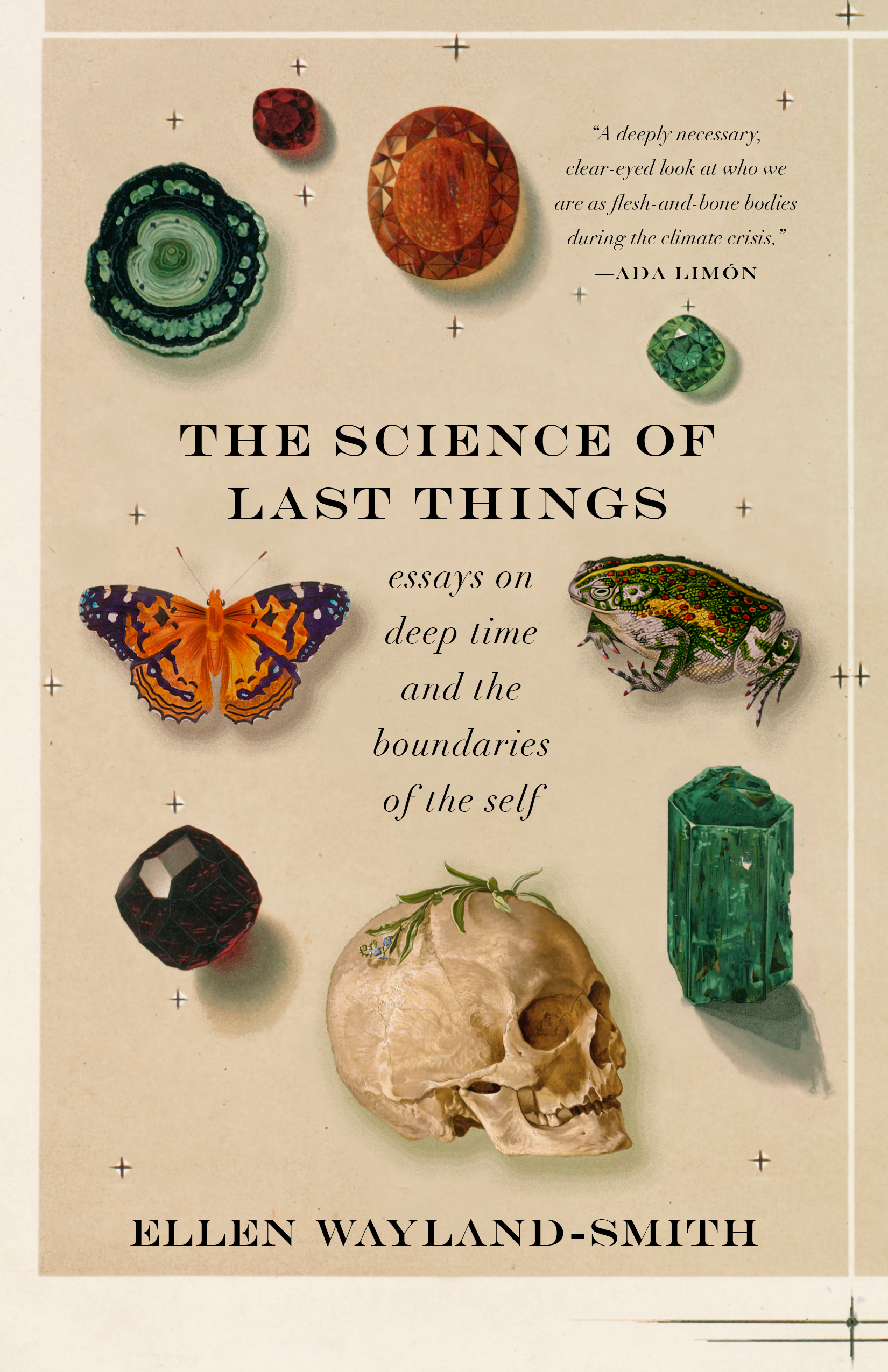 |
The Science of Last Things By Ellen Wayland-Smith 208 pp. Milkweed Editions, $18.00 Released October 2024 |
The essays in Ellen Wayland-Smith’s collection The Science of Last Things: Essays on Deep Time and the Boundaries of the Self are blindfolded dancers delicately tracing the border between intellectual analysis and profound emotion. While their shining footsteps lie mostly in the realm of thought, occasionally the mask slips or the feet wander. This choreography is understandable; Wayland-Smith ponders here the death of her father, her own cancer diagnosis, and childbirth, events that “shatter the limits of personhood” and could threaten to throw anyone into emotional chaos. In resisting that chaos—and with it, melodrama and sentimentality as she “bear[s] witness[…]as a person”—Wayland-Smith creates a space in which she invites the reader to gaze with her upon the “mystery and the pain of incarnation.” Rather than displacing her own pain onto us, this process becomes one of pleasurable connection, “joining sinew to spirit with imperfect joints, patiently stitching word to bone” in the hope of a chance to be whole.
These are personal essays that touch on memory, cancer, grief, faith, rocks, the nature of bodies in several senses, and the quest to understand our own minds. However, the most important “person” in these essays is the narrator herself: brainy, thoughtful, eloquent. The character of Ellen, as opposed to the narrator, mostly appears in brief images—walking with her daughter, picking up shells on the beach, riding a carousel—before the narrative voice takes over to explore medical history, say, or Freudian psychology, or monster movies. In giving us context for the thinking-through of her topics, Wayland-Smith takes us back in time as far as classical philosophy or even farther, as in the meditations on geology in “Quartz Contentment” and “Lapidary Medicine,” before bringing us forward in time. All of this, together with the luminous writing, projects a cinematic effect, if one of documentary rather than feature film.
These are generally not confessional essays. The essay closest to that particular form is “Outis,” a meditation on the author’s college-era nervous breakdown and its attendant loss of a feeling of self. Here, Wayland-Smith searches for meaning through the medical history of melancholy and ecstatic religious experiences. The history of healing comes up quite a lot in this collection, in fact. Citing Pythagoras’s cosmology based on the monad, as well as amputee “body schema” research that has roots in the Civil War, “Body Map” investigates the borders of the body as it relates to bearing children: why do we still feel a visceral connection to that which was once part of our bodies, even when it has been separated from us?
In “Natural Magic,” we encounter another kind of body map: Zodiac Man, an early anatomical diagram superimposed with the constellations of the zodiac on the body parts the artist believed the stars were best equipped to heal, a healing that often involved bloodletting. Essaying on centuries-old ideas of our bodies’ connections to nature and the cosmos provides new ways for Wayland-Smith to think about her own healing through chemotherapy, a tree-derived treatment that also requires bloodletting. Another cancer essay, “The Atavist,” explores fascinating research on cancer cells, which employ survival functions similar to those of the prehistoric protozoa that gave rise to life on earth.
Though the writing never left me cold, I couldn’t help feeling that the author sometimes hid emotion behind a screen of intellect. Wayland-Smith herself might agree with that assessment. As she reports in “Quartz Contentment,” medication she takes tends to flatten her emotion, and she was raised in a family that frowned on excessive emotional displays. She reports sometimes feeling self-conscious about this possible weakness in her humanity—this, and her capacity to hold on to memories, as she discusses in “Camera Obscura.” And yet, she writes, maybe there is value in responding to the world with the perspective of a stone such as quartz: taking a long view on disturbing events, simply being in the face of chaos and grief. Maybe gratitude for an impermanent experience is most important, come what may.
Some of Wayland-Smith’s loveliest writing swirls around the unsettling, the anxious. “American Pastoral” shows us her family’s annual vacation spot, a cabin on Lake Ontario not far from the Nine Mile Point nuclear plant, one of the oldest in the country. Discussing mutated nature as it appears in literature from biblical plagues to Cujo, the essay explores the uneasy relationship between humans and the natural world. This she epitomizes through her family’s love-hate relationship with the spot on the lake, which offers up possibly dangerous water snakes, too many dead fish and frogs, and strangling algae, while nuclear reactors glow orange in the distance: “All we have is this fallen planet, and fallen things require our love—even when we suspect that love isn’t strong enough to save [our children], or us.” The essay ends with her daughter riding a rusty bicycle, which is a “human-made machine left for scrap” that “still holds together, barely.” The image holds both terror and beauty: “[…]the canopy of blackening trees above the swamp pulses with hundreds of fireflies[…]as if the stars had been netted and dragged down to earth, an artificial firmament. I watch and listen as the creak of the bicycle springs grows dimmer and her silhouette is swallowed by the dusk.”
We live in a world in which machines seem poised to replace working writers, actors, and visual artists. In this world, perspectives like that of Wayland-Smith’s witness “as a person” are more important than ever. If the pain we experience “smashes all idols,” even the “free, willing, and inviolate self,” Wayland-Smith shows us the workings of what might lie beyond that pain and, in doing so, helps us remember our humanity.
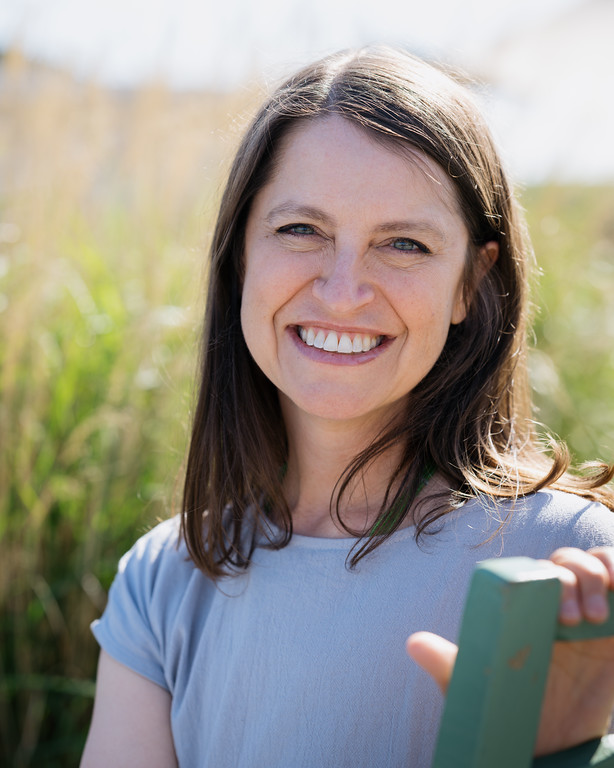
Christi Leman is a writer and musician living in Utah Valley. Her essays can be found in Lake Effect, Pembroke Magazine, The Utah Monthly and The Adroit Journal. She is a 2024 winner of the Utah Original Writing Competition and is working on a book of essays about hiking Scotland’s John Muir Way.