Ferocious and Featherlight
Pondering Womanhood in Yoke & Feather
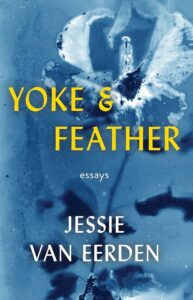 |
Yoke & Feather By Jessie Van Eerden 212 pp. Dzanc Books, $17.95 Released November 2024 |
Jessie Van Eerden’s Yoke and Feather explores what it means to be a woman of faith without being a mother. Without unloading drama or exposing old wounds, Van Eerden carefully unwraps the complexities of womanhood and worth when they are untethered from youth, husbands, and children. I am chagrined to admit that I began the book with an agenda: I sought out a Southern woman essayist of faith because I hoped to find an author whose experience would mirror my own.
What Yoke and Feather delivered did not match the image I had in my head. Instead, it delightfully subverted my expectations and, with exquisite craft and attention to language, lured me into a mind unlike my own and asked me to stay awhile and pray.
The book’s first major section, “Blessing Book,” gathers essays that read like prayers. Pieces such as “Blessing for Lice Check,” “Blessing for the Demolition Derby,” and “Blessing for Homecoming” are short, reverent, lyrical, and sincere. Even Van Eerden’s longer essays, such as “Sunday Morning Coming Down,” move like prayers that have lost their focus, only to snap sharply back to the topic at hand and give us a glimpse of the woman behind the keyboard, the woman on her knees.
Her second section, “We Slip Sluiceward,” shifts from the directness of blessing to a quieter, more contemplative mode. The form is looser, and these essays are more patient in their unfolding than those that came before. Van Eerden allows her reader to drift with her, trusting that the deepest questions are not always answered outright but lived beside. If the first section teaches us how to pray through the ordinary, this second one teaches us how to listen.
What strikes me most is Van Eerden’s genre-bending speculative nonfiction. She breathes life into biblical stories the way God breathed life into Adam. She does not just speculate on the women in the Bible—the woman with an issue of blood, Martha, Mary, Ruth. She places them in undefined settings and treats them as actors in a play, testing them with scenarios that make these characters more real. She humanizes women who have only ever had a verse or two as the summary of their entire existence. Anecdotes are expanded, and with newfound grace, we meet the women of the Bible; through them, we meet Van Eerden herself. Each time my mind started to wander toward questions of genre or look for deeper meaning, her writing pulled me back in and reminded me that the point was not classification but encounter.
This attention to encounter is perhaps the true strength of the book. Van Eerden does not offer arguments or thesis statements; she offers presence. She writes with a devotional steadiness that refuses spectacle. Her craft is subtle, and I can only assume this kind of subtlety is achieved after years of patiently unraveling her own life. She has the gift of making the small feel eternal. A meal with a friend, a church service, a memory of childhood—all become occasions for spiritual inquiry. Her essays suggest that the divine hides not behind miracles but inside the soft friction of daily living.
As a reader, especially one who came looking for reflections of my own Southern womanhood and my own faith, I found myself humbled by the expansiveness of Van Eerden’s gaze. She is not writing to reassure women who resemble her. She writes to open the door to anyone willing to sit quietly inside her contemplative world. In doing so, she complicates easy narratives about womanhood and religious life. She does not disparage those who want motherhood or glorify the childless woman; instead, she treats the potential life of motherhood as one worth exploring. She makes me want to make room for more women who will never fit the mold.
There is courage in that, a quieter and more literary courage than the kind often praised. She risks being misunderstood, risks being labeled too spiritual for secular readers and too unorthodox for religious ones. Yet she writes anyway, with a voice fully her own, trusting that sincerity still matters in a genre increasingly shaped by irony and detachment.
By the time I finished Yoke and Feather, I was glad she did not mirror my life. I valued that she had encouraged me to look again at the world I already inhabit and ask questions. She writes essays that can pray, uses language that can kneel, and holds a faith that can be both ferocious and featherlight. This book lingers not because it answered my questions, but because it asked better ones.

Gwen Rich suffers from workoholism, always busy busy busy with teaching, reading, writing, doing homework, answering emails, or doing anything at all other than resting. She teaches freshman writing to pretend to have some control over the future, and she knits to keep her hands busy. Nothing, however, has even been able to still her mind.